
Knowledge blog > Micronutrient lexicon
Glycine
Themen dieses Blogartikels:
Table of contents
- Definition: What is glycine?
- What effect does glycine have?
- Does glycine help with sleep?
- Glycine deficiency symptoms
- Glycine's effect on hair
- Trimethylglycine (Betaine)
- What should you pay attention to when taking glycine?
- How much glycine per day?
- When to take glycine?
- Foods containing glycine?
- Bibliography & Sources
Definition: What is glycine?
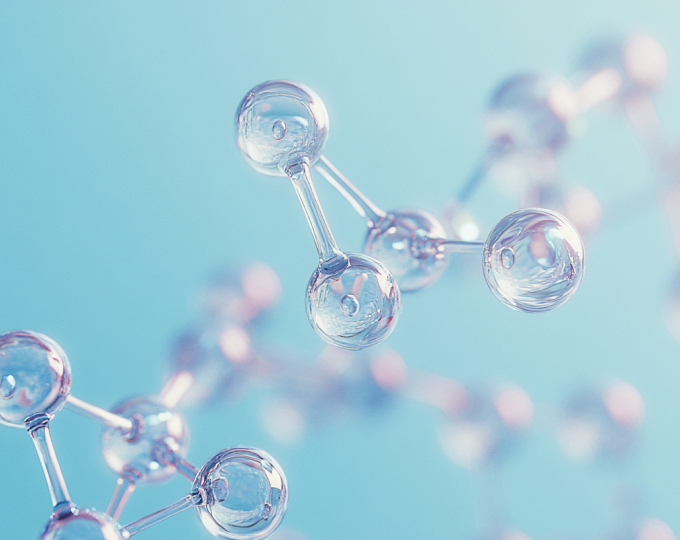
Glycine is the smallest and simplest proteinogenic amino acid found in nature. "Proteinogenic" means that this amino acid is directly involved in the synthesis of proteins. Because its structure is so simple, glycine is extremely versatile. This smallest amino acid, with a hydrogen atom side chain, is an important building block of almost all proteins¹ and is involved in numerous bodily functions: glycine plays a role in collagen synthesis , sleep , detoxification , the nervous system , and methionine balance, among other things.
Scent & taste of glycine
In its pure form, it is a colorless and odorless crystalline solid with a sweet taste. The name glycine is derived from "glykýs," the Greek word for "sweet." Alternative names include aminoacetic acid and glycocoll. It can be added to foods as a flavor enhancer under the designation E640.²
What is L-glycine?
In biochemistry, amino acids are usually distinguished between the L- and D-forms. This isn't necessary for glycine: its structure is so simple that, strictly speaking, there is neither an L- nor a D-form. If you do happen to see the term "L-glycine" somewhere, don't worry – it's simply glycine. L-glycine and glycine are exactly the same.³
What effect does glycine have?
Glycine, an amino acid, is present in low concentrations in almost all proteins. It is involved in numerous biochemical processes and has a wide range of effects in the body. Studies suggest that glycine plays an important role in regulating sleep . Therefore, taking glycine in the evening may reduce the time it takes to fall asleep and improve sleep quality and deep sleep phases.⁴
Functions of glycine in the body
In the central nervous system, glycine functions as both an inhibitory and an excitatory neurotransmitter, depending on the context. Among its functions is the reduction of nerve cell excitability, which has a stress-reducing and calming effect. In combination with glutamate, however, it exerts its excitatory effect, which is important for brain function and memory.⁵ Furthermore, glycine is involved in the liver's detoxification process.⁶
One of the central functions of this substance is collagen formation . As a structural protein, collagen is found, among other places, in the skin, joints, and connective tissue. Studies have also shown that it influences blood sugar regulation and metabolism.⁷ Furthermore, there is initial evidence that glycine has a positive effect on athletic performance and subsequent recovery.⁸
Advertisement
- Organic extra virgin olive oil (Omega 9 fatty acid) from Italy
- From controlled organic cultivation, without pesticides & artificial fertilizers
- 11 valuable fatty acids
- Careful harvesting of the olives
- Gentle cold centrifugation process <27°C - ensures preservation of aromas & polyphenols
- Mild-fruity oil without additives
- Organic quality, vegan & vegetarian
- Developed with doctors & experts

Does glycine help with sleep?
Glycine helps lower core body temperature and calm the nervous system.⁹ It also causes vasodilation and modulates sleep-regulating neurons. Taken together, these effects can lead to improved sleep quality.
Glycine capsules as a sleep aid
Human studies have shown that taking 3 grams of glycine before bed may reduce daytime sleepiness and alleviate fatigue due to lack of sleep.10 It is recommended to take glycine together with magnesium¹¹ and adaptogens such as ashwagandha¹², which are also believed to promote sleep.
Glycine deficiency symptoms
Since glycine plays a crucial role in the synthesis of collagen, creatine, and hemoglobin, a deficiency can have far-reaching consequences. These include, among others, sleep problems, increased susceptibility to stress, muscle pain, sallow skin, and weak connective tissue. Slowed wound healing and mental exhaustion can also be among the symptoms.
Risk groups for glycine deficiency
Older people are particularly affected, as the body's ability to synthesize amino acids can decrease with age. However, individuals with increased protein requirements, including athletes , pregnant women, and breastfeeding mothers, can also develop a deficiency. Furthermore, chronic kidney or liver diseases, celiac disease, and Crohn's disease can lead to the body producing too little glycine or being unable to utilize it effectively.¹³
Generally, a glycine deficiency is not a common problem. Since the body produces glycine from L-serine, a deficiency usually results in a deficiency of both amino acids.
Advertisement
- Bestseller product & top ratings
- Passion fruit with a subtle vanilla note
- No unpleasant aftertaste
- With glycine – the sweet amino acid with added benefits (instead of sugar)
- The smart alternative to the protein shake for every day
- 13 Premium Amino Acids & Zinc
- D-Galactose & D-Tagatose
- With vitamins C and B6 in powder form

Glycine and its effect on hair
Glycine is the most abundant amino acid in collagen. This structural protein is found, among other places, in the scalp, where it stimulates the formation of new, healthy hair follicles. Collagen also helps improve blood circulation in the scalp and supply the follicles with nutrients.¹⁴ Indirectly, glycine can therefore support hair anchorage and stability.
Glycine as a component of keratin metabolism
Furthermore, glycine is involved in keratin metabolism – it is therefore needed to produce the basic building blocks of the hair fiber. Moreover, since a hormonal imbalance with elevated cortisol levels can lead to stress-related hair loss, glycine also has a calming effect in this area.
Trimethylglycine (Betaine)
Betaine, also known as trimethylglycine or TMG, is a derivative of the amino acid glycine. Derivatives are chemical compounds derived from a parent substance. Betaine is found in many plants, such as broccoli, spinach, and sugar beets, as well as in seafood.¹⁵
What are the properties of betaine?
It acts as a so-called methyl group donor, meaning it can provide the body with methyl groups that can then be transferred to other molecules. This is important, for example, for converting homocysteine into methionine, which reduces the risk of cardiovascular disease.¹⁶
Furthermore, trimethylglycine is essential for liver function¹⁷, supports muscle performance¹⁸ and improves the osmosis regulation of cells.
How glycine and trimethylglycine work together
Glycine and trimethylglycine act in the body in different, yet complementary ways. Glycine supports protein and glutathione synthesis, which improves antioxidant capacity. Trimethylglycine, in turn, reduces homocysteine, thereby protecting the cardiovascular system.
Glycine-betaine compounds, when combined, offer significant health benefits, as they can increase stress resistance, support cell protection, and promote regeneration. Both can interact via the methionine cycle to ensure an optimal methylation balance. This means that sufficient methyl groups are available for all biochemical processes requiring methyl groups to function optimally. These processes include, for example, gene regulation, hormone metabolism, and lipid metabolism.
What should you pay attention to when taking glycine?
Since glycine can be produced by the human body itself, it is considered a non-essential nutrient. Various precursors, such as serine and threonine, are required for glycine synthesis. Glycine can also be obtained through food.
Glycine in powder form
Nevertheless, it can happen that the body's own production is insufficient to meet its needs. Therefore, it is also referred to as a conditionally essential or semi-essential amino acid. Under certain circumstances, it can be quite beneficial to take glycine as a dietary supplement – for example, in cases of insufficient protein intake, malnutrition, late pregnancy, or diabetes.
Advertisement
- Milk & cocoa in balance – extra creamy, full-bodied, harmonious
- 45% fine cocoa – balanced aroma, delicate cocoa notes, smooth texture
- Modern sweetness – with tagatose & galactose instead of conventional sugar
- 0% refined sugar – full flavor, less sugarSustainable premium cocoa – from Peruvian smallholders
- Bean-to-bar production – from the origin of the cocoa bean to the finished bar

How much glycine per day?
Typical glycine dosages usually range between 1 and 10 grams per day.1⁹ Good to know: Side effects are not to be feared, as glycine cannot be overdosed.10
When to take glycine?
If you want to improve your sleep quality with the help of this amino acid, take the supplement about 30 to 60 minutes before going to bed.
Which foods contain particularly high levels of glycine?
Since glycine is a protein building block, this nutrient is found primarily in protein-rich animal foods such as meat, fish, milk, dairy products, eggs, and gelatin. However, protein-rich plant foods, especially legumes like soybeans, lentils, and peas, are also good sources of glycine.
Advertisement




More blog articles on the topic







This encyclopedia entry is based on carefully researched sources:
Bibliography & Sources
- chemie.de/lexikon/Glycin.html
- flexikon.doccheck.com/de/Glycin
- burgerstein-foundation.ch/de-DE/wissen/naehrstofflexikon/glycin
- onlinelibrary.wiley.com/doi/abs/10.1111/j.1479-8425.2006.00193.x
- mpg.de/312638/forschungsSchwerpunkt1
- mdpi.com/1422-0067/22/6/3129
- mdpi.com/2076-3921/11/1/154
- mdpi.com/2075-4663/12/10/265
- naturundtherapie.at/wp-content/uploads/2024/11/infoblatt-glycin.pdf
- mdpi.com/2075-4663/12/10/265
- pmc.ncbi.nlm.nih.gov/articles/PMC3703169/
- pubmed.ncbi.nlm.nih.gov/31728244/
- vitalstoff-lexikon.de/Aminosaeuren/Glycin/Mangelsymptome
- ifue-haartransplantation.de/ratgeber/haarfollikel/
- flexikon.doccheck.com/de/Betain
- mt-portal.de/aktuell/erhoehte-homocysteinwerte-machen-die-aorta-steifer-und-weniger-elastisch/
- pubmed.ncbi.nlm.nih.gov/23861108/
- issn.biomedcentral.com/articles/10.1186/1550-2783-7-27
- burgerstein-foundation.ch/de-DE/wissen/naehrstofflexikon/glycin
- apotheke-am-medizinzentrum.de/gesundheitsbibliothek/index/glycine/

